
Archive · Reference document
The One Piece bounty system, as One Piece Wanted presents it
Taken one at a time, bounties are nothing complicated: a name, a face, a sum. What is complicated is trying to represent the whole system. That is what One Piece Wanted does, and the work's own limits show up at once — amounts the story does not give and may never give, states it never spells out, existences neither confirmed nor ruled out.
Those gaps, and many more details of the same kind, called for a decision: what to display, what to assert, where to stop so as to invent nothing. This page gathers those decisions and explains them. Each section reads twice — first what the work establishes, then what One Piece Wanted makes of it.
01Who issues a bounty
What the work says
The historical issuer is the World Government, acting through the Marines: a dedicated department at headquarters sets the amount, based on the threat the institution credits the target with. A bounty is only worth anything once circulated — its whole purpose is to open the hunt to as many people as possible, so the poster goes out the moment it is issued, carried by the News Coos that also deliver the newspaper. That is often how a character finds out about his own bounty: it lands in his hands.
A second issuer appears at the very end of Wano, in chapter 1058. Cross Guild, founded by Buggy, Crocodile and Dracule Mihawk, puts a price on Marines. The inversion is complete: a criminal organisation publishes notices on the soldiers meant to arrest it, and pays for their elimination as readily as for their capture.
What One Piece Wanted makes of it
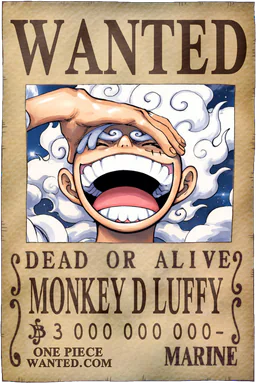
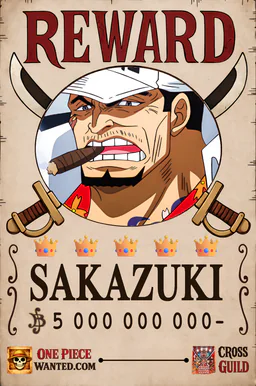
One Piece Wanted carries over both issuers from the work: the Marines on behalf of the World Government, who account for the vast majority of the notices, and Cross Guild for the ones aimed at Marines.
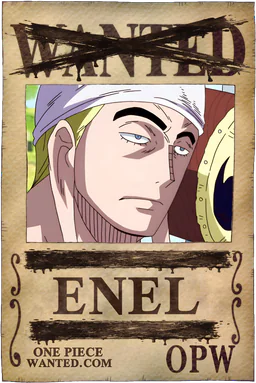
A third label exists on this site alone: OPW, that is, One Piece Wanted itself. It carries the characters who can be shown to be hunted by nobody. Rather than leave them out, One Piece Wanted grants them a page like any other, with a poster built on the WANTED template where everything that presupposes a bounty is struck through: the word WANTED, the DEAD OR ALIVE clause, the space for the amount. There is no issuer here, because there is no bounty — the signature belongs to the site, not to any institution of the work. Why these characters get a page is set out further down.
02Cross Guild: symbols, and what they are worth
What the work says
A Cross Guild notice carries no sum. It carries symbols, and the official sources give their scale: a crown is worth one billion berries, a star is worth one hundred million.
The important point lies elsewhere: the rate is set by rank, not by the man. Cross Guild does not assess an officer's individual danger, it applies a tariff attached to a function. With one reservation the sources state themselves: an exceptional reputation can be worth more than the rank, and Garp, a vice admiral, is priced at an admiral's rate.
- One crown — 1,000,000,000 berries
- One star — 100,000,000 berries
What One Piece Wanted makes of it
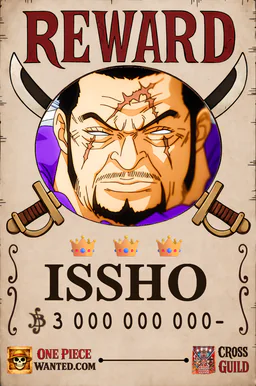
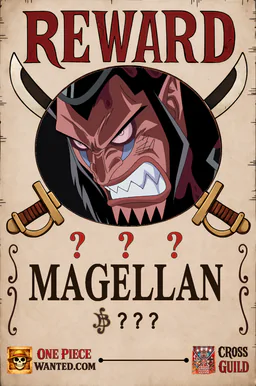
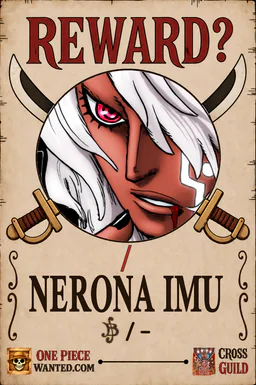
One Piece Wanted displays the amount alongside the symbols: the scale converts it exactly, and it reads faster than a row of crowns and stars. It is an addition by the site, not a piece of data from the poster.
Two other situations sit under the same Cross Guild label, and the poster tells them apart.
A few notices fall outside the scale. These are cases tied to the Marines directly or indirectly — a neighbouring function, a service left behind — whose rank says nothing about what they would be worth. The notice still makes sense, its value cannot be derived: One Piece Wanted assumes it exists, never how much it is worth, and the poster carries question marks where the symbols belong.
Other notices deliberately extend the system to members of the World Government who are not Marines. The official rule revealed by Oda names the Marines; it does not say whether Cross Guild targets only those who can come after it, or the government apparatus the Marines stand for. Nothing includes them, nothing rules them out: their existence is marked as uncertain rather than settled, and the poster's heading becomes “REWARD?”.
03The amount the public was never given
What the work says
When a bounty shows no amount, what is missing is in the narrative, not in the world of One Piece. A bounty without a figure would not hold up: the poster circulates, bounty hunters work from it. The amount therefore exists; it simply was never disclosed to the public.
That silence is in no way final. What gets shown later depends on how the work unfolds and on decisions that belong to its author alone.
There is a variant: sometimes the work gives a floor instead of an exact amount. We know the bounty exceeds a given sum, without knowing by how much.
What One Piece Wanted makes of it
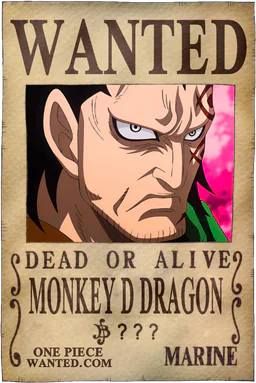
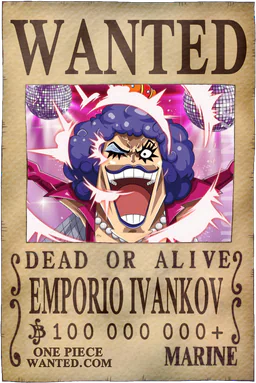
One Piece Wanted distinguishes two forms of this silence.
Some bounties have an established existence and an amount the official sources never revealed. The poster then carries “???” where the sum belongs: no estimate, no range.
Others carry an amount followed by a plus sign. The sign is not a rounding: it says the work gave a minimum, not an exact value.
04Why some characters have no bounty
What the work says
Considerable characters have no bounty at all, and it is not an oversight. The system does not cover everyone: it draws a map of what the World Government took into account, and of what it judged threatening enough to price.
The most structuring rule comes down to the position held. In a criminal organisation, only the leaders and the figureheads are priced; subordinates only get a bounty in the notable crews, those of the Emperors and the large fleets. A rank-and-file member without a bounty is therefore not a hole in the map, it is the rule.
Then comes jurisdiction, and it takes us back to the principle of the first section: a bounty answers a threat to the issuer. Wano stayed closed for centuries, the sky islands sit outside the blue sea, Fish-Man Island lies beneath it — what happens there is beyond the World Government, which has no reason to see a threat to itself in it. Other cases are simply a matter of status: a villager nothing ever marked as a threat has no reason to be priced at all.
What One Piece Wanted makes of it
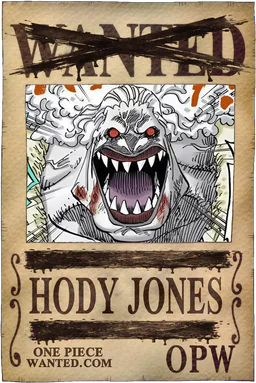
These characters get a page like any other, and it is deliberately a page rather than a blank. “Does Hody Jones have a bounty?”, “is Kinemon wanted?” are questions people actually ask, and answering no, with the reason, is content in its own right.
The groupings stand out: the protagonists of Wano, the antagonists of the sky islands, the Fish-Men — whole territories outside the World Government's jurisdiction, plus a handful of individual cases.
It is a deliberate editorial choice, and it follows from one of the site's aims: rediscovering One Piece through its bounties. A character without a bounty can matter as much as one who carries a price, and leaving them out of the catalogue would simply make them impossible to find here. The same reason keeps the undisclosed amounts and the existences the work never settled: they are nuanced cases, and they too can interest someone who already knows the story.
05When the bounty's existence is unsettled
What the work says
There is a third case, distinct from the previous two, and it is the least comfortable. For some characters a bounty would make sense — their record would justify one — but the work has neither shown it nor ruled it out. The question stays open, and nothing lets us close it.
The profile recurs: a character whose stature the work established without ever developing his file. A fighter from a major crew, whose crewmates carry bounties and whose danger is in no doubt, may simply never have had a poster on screen. To which are added the ambiguous institutional positions, where the status itself prevents any ruling.
What One Piece Wanted makes of it
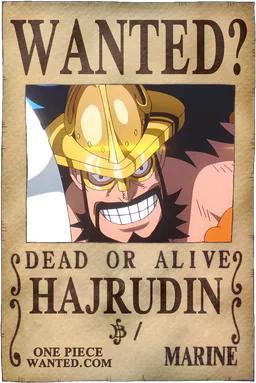
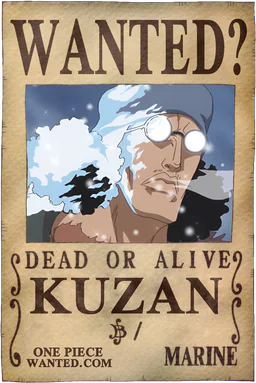
This is where One Piece Wanted takes its most visible liberty: it draws a poster the work never published.
The poster says so itself. The word WANTED becomes “WANTED?”, the amount shrinks to a slash, and the page states it in plain words: the existence is plausible, it is not confirmed. It is a proposed reading, not a source. If the work ever settles the question, the bounty changes category.
06What ends a bounty
What the work says
A bounty does not expire. As long as death is not confirmed the notice stands, even after decades without news — which is what lets a bounty hunter turn up holding a century-old poster.
Two events end one. A higher bounty issued on the same person supersedes the previous notice: that is the ordinary mechanism of progression. And confirmed death ends the hunt. Other particular situations can suspend a notice or extinguish it, without the work making a rule of them.
What One Piece Wanted makes of it

A bounty that has come to an end keeps its page, and the state shown says which of the two endings applies: superseded, when a higher amount has been issued since; inactive, when nothing keeps it running.
One person therefore occupies several pages, one per amount.